

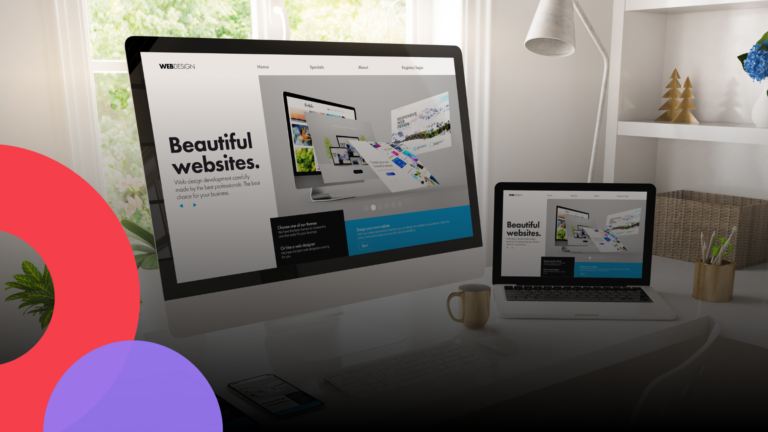
Most websites don’t fail because they look bad — they fail because they don’t convert. You can have a visually polished, modern website and still struggle to generate leads, enquiries, or sales. That’s because website success isn’t measured by aesthetics — it’s measured by conversion rate.
A website is a decision-making tool. Every visitor is asking, often subconsciously, “Can this business help me, and can I trust them enough to take the next step?” If your website doesn’t answer that quickly, clearly, and confidently, users leave. And when they leave, your traffic becomes wasted opportunity.
1. Built for appearances, not conversions
One of the biggest reasons websites don’t convert is because they’re built like digital brochures instead of conversion-focused websites. Businesses prioritise branding, layout, and visuals, but don’t think about user behaviour or how people actually move through a site.
A high-converting website starts with a clear goal — whether that’s generating leads, driving bookings, or increasing sales — and is structured to guide users toward that outcome. Without that intentional structure, even high traffic won’t translate into results.
2. Lack of clear messaging
Website conversion rates drop significantly when messaging isn’t clear. If a user lands on your homepage and can’t immediately understand what you do, who you help, and why it matters, they’ll leave.
This is where website messaging strategy becomes critical. Strong websites communicate their value within seconds. They remove ambiguity and make it obvious why a user should stay, explore, and take action.
Clarity isn’t just important — it’s the foundation of conversion.
3. Talking about your business instead of your customer
Many websites focus too heavily on the business itself — its history, credentials, and services — rather than the customer’s needs. But users aren’t searching for a business; they’re searching for a solution.
A conversion-optimised website shifts the focus. It speaks directly to the user’s problem, reflects their situation, and clearly positions the business as the solution. This creates relevance, which is what keeps users engaged and moving forward.
4. Poor user experience (UX) and no clear path
A common issue affecting website conversion rates is poor user experience. If navigation is confusing, calls to action are unclear, or there are too many competing options, users hesitate — and hesitation leads to drop-off.
Every page on a website should have a clear purpose and a defined next step. Whether it’s “Get a quote,” “Book a call,” or “Submit an enquiry,” the action should be obvious and easy to complete.
Good UX doesn’t just make a site usable — it makes it effective.
5. Lack of trust and credibility signals
Trust is one of the biggest drivers of conversion. Without it, users won’t take action, regardless of how strong your offering is.
High-converting websites integrate trust signals throughout the experience. This includes testimonials, case studies, reviews, real outcomes, and clear proof of capability. These elements reduce perceived risk and give users confidence in their decision.
Without trust, traffic doesn’t convert.
6. Website speed and friction
Website performance plays a major role in conversion. Slow load times, cluttered layouts, and overly complex forms all create friction — and friction reduces conversions.
A fast, user-friendly website keeps users engaged and moving. Every second of delay, every extra click, and every unnecessary step increases the likelihood that a user will leave before taking action.
Reducing friction isn’t just a technical improvement — it’s a commercial one.
What actually works: conversion-driven websites
Websites that convert well follow a consistent set of principles. They prioritise clarity over cleverness, simplicity over complexity, and outcomes over information.
They guide users toward a single action, rather than overwhelming them with options. They speak in terms of results, not just services. And they build trust throughout the entire journey, not just at the end.
Most importantly, they are designed with intent. Every section, every word, and every interaction has a purpose — to move the user closer to a decision.
The shift from website to growth engine
The most important mindset shift is this: your website isn’t just an online presence — it’s a lead generation and conversion tool.
A well-optimised website attracts the right audience through search, engages them with clear messaging, builds trust quickly, and converts them into enquiries or customers. When done properly, it becomes one of the most powerful assets in your business.
The bottom line…
Most websites don’t convert because they’re built backwards. They prioritise design over strategy, information over action, and business messaging over customer needs.
What actually works is far more deliberate — clear messaging, strong user experience, fast performance, and trust-driven content, all aligned toward a single goal: conversion.
How MNO Ventures helps
At MNO Ventures, we don’t just build websites — we build conversion-focused digital platforms designed to generate real business outcomes.
We combine website design, SEO strategy, and conversion optimisation to ensure your site doesn’t just attract traffic, but turns that traffic into enquiries, leads, and revenue. Every website we create is built with intent — structured to guide users, reduce friction, and maximise performance.
If your current website isn’t converting, it’s not just a design issue — it’s a strategy issue. And that’s exactly where we come in.